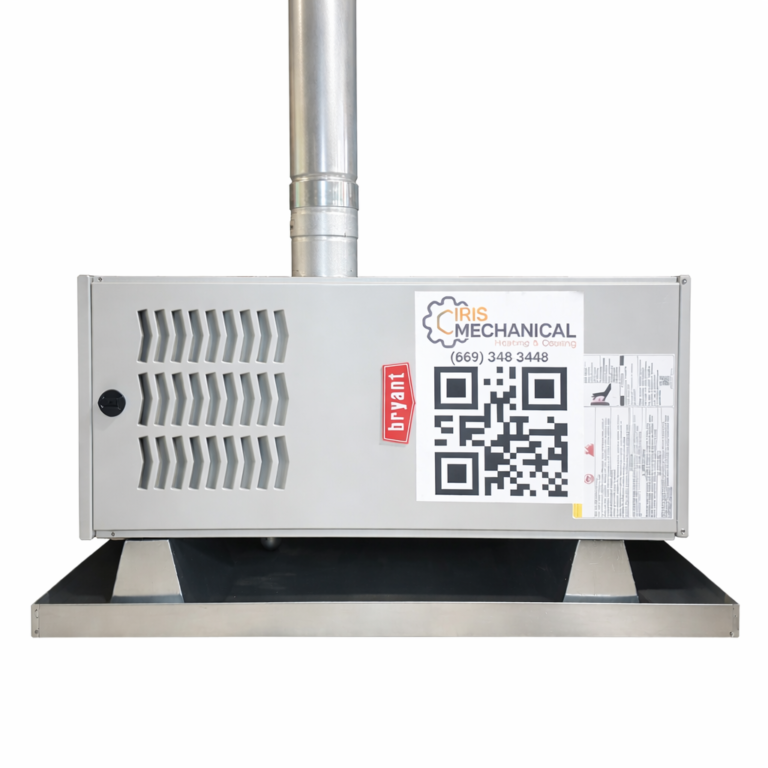

Adding AC to an Older Home
What Bay Area homeowners should know before adding air conditioning to an older home.
FAQ: Can You Add Air Conditioning to a Home That Never Had It?
Yes. In most cases, air conditioning can be added to a home that never had it. Depending on your home's existing heating system, ductwork, electrical capacity, and layout, the best solution may be central air, a heat pump, or a ductless mini split. An in-home HVAC evaluation can help determine which option is the best fit.
Introduction
If you own an older Bay Area home that has always relied on open windows, ceiling fans, or cooler evening temperatures, you're not alone. Many homeowners are finding that what once kept their homes comfortable isn't always enough during today's longer heat waves and warmer summers.
Every older home is different, which means there isn't just one way to add cooling. Whether your home already has a forced-air furnace, has no ductwork, or you're considering a heat pump as part of a larger home upgrade, there are often several solutions worth exploring.
In this guide, we'll help you compare the cooling options available for older Bay Area homes and walk through the key factors to consider when choosing the right system for your home.
Have a specific question? Jump to your topic below.
Why Many Bay Area Homes Were Built Without Air Conditioning
Can You Add Central Air?
What About Existing Ductwork?
Can You Keep Your Existing Furnace?
What if I Don’t Have Ducts?
Can I Add AC Without Major Remodeling?
How do Modern HVAC Retrofits Work?
Which Cooling System is Right for Me?
How Much Does It Cost?
How Long Does It Take?
Other Common Questions
Why Many Bay Area Homes Were Built Without Air Conditioning
If you've lived in the Bay Area for years, you've probably noticed something interesting: many neighborhoods are filled with homes that have furnaces but no air conditioning.
These homes were built during a time when opening a few windows in the evening was usually enough to cool the house. Because of that, builders focused on heating for the winter months rather than installing cooling systems.
Many of these homes were also designed with features that reflected the building practices of the time, such as smaller electrical panels, simpler duct systems, or, in some cases, no ductwork at all.
This is especially true in many older Bay Area neighborhoods, including Santa Clara, Sunnyvale, Campbell, and Cupertino, where homes were often built long before air conditioning became a standard feature.
Today, homeowners are facing a different reality. Bay Area summers aren't what they used to be. Extended heat waves have become more common, and the San Jose area now experiences nearly 50% more days above 90°F than it did during the 1960s, when many of today's Bay Area homes were built.
For many locals, surviving summer has always involved a familiar microclimate dance: opening the windows at night, closing them before the afternoon heat, and hoping the house stays cool. While that routine still helps, today's longer heat waves mean discomfort has become more noticeable and difficult to escape. And with more people working from home and families spending more time indoors, what was once considered a luxury is increasingly viewed as an investment in comfort, health, and quality of life.
Fortunately, today's modern cooling systems can restore comfort to most older homes without the major renovations homeowners often expect.
Can You Add Central Air If Your Home Already Has Forced-Air Heating?
In many cases, yes.
If your home already has a forced-air furnace, you're often starting from a great place. That's because your home may already have some of the infrastructure needed to distribute cooled air throughout the house.
However, adding central air isn't as simple as connecting an air conditioner to an existing furnace. Every home is different, and several factors determine whether your current system can support air conditioning or whether modifications are recommended.
The first step to determining whether you’re a fit for central air is to get an in-home evaluation.
During an in-home evaluation, an HVAC specialist will typically assess:
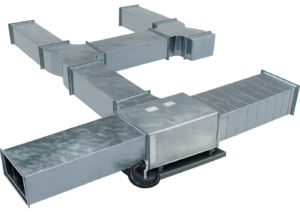
- The condition and size of your existing ductwork
- Whether your furnace is compatible with a central air system
- Your home's airflow and comfort needs
- Available space for indoor and outdoor equipment
- Your electrical system and whether any upgrades may be needed
For some homeowners, the existing ductwork may only need minor modifications. For others, portions of the duct system may need to be redesigned or replaced to ensure proper airflow and efficiency. Fortunately, these improvements are often far less extensive than homeowners expect and can frequently be completed without major disruption to the home.
The goal isn't simply to make air conditioning work, it's to make sure it works well.
Many homeowners assume that if air already comes through the vents during the winter, the same ductwork will automatically work for cooling.
Sometimes that's true.
But heating and cooling place different demands on an HVAC system. Ducts that perform adequately for heating may not always deliver balanced, efficient cooling throughout the home. Factors such as duct size, airflow, insulation, leaks, and the home's layout can all affect performance.
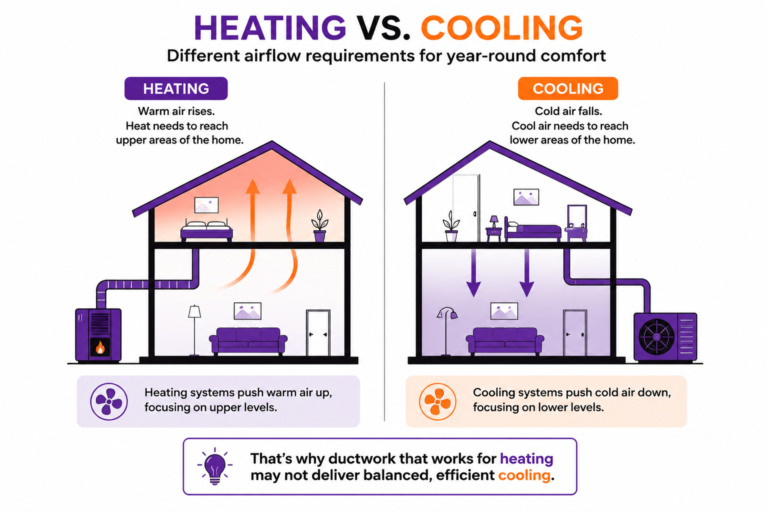
Homeowners often turn to an HVAC specialist to evaluate how air moves through the home, inspect existing equipment and ductwork condition, and identify any issues before determining whether the existing system can support central air or what modifications may be needed.
Can You Keep Your Existing Furnace?
In many cases, yes. You may be able to keep your existing furnace if:
✓ It's in good condition.
✓ It's properly sized.
✓ It's compatible with a new central air system.
✓ It still has a useful service life remaining.
In other situations, replacing both systems at the same time may make more sense, especially if:
- Your furnace is nearing the end of its expected lifespan.
- You're considering upgrading to a high-efficiency heat pump, which provides both heating and cooling in a single system.
Learn more about the differences between heat pumps and furnaces in our Heat Pump vs. Furnace guide.
The right approach depends on your home's existing equipment, your long-term goals, and your budget.
What If Your Home Doesn't Have Ductwork?
Yes. A home without ductwork can still have air conditioning.
One of the biggest misconceptions homeowners have is that no ductwork means no air conditioning.
Fortunately, that's not the case.
Many older Bay Area homes were built without ductwork because they relied on radiant heat, baseboard heating, wall furnaces, or other heating systems that didn't require air to be distributed throughout the home. While this can make adding traditional central air more involved, it doesn't mean your cooling options are limited.
Today, homeowners have several ways to add air conditioning, depending on their home's layout and existing infrastructure.
In some homes, installing new ductwork makes the most sense and provides whole-home cooling through a central air system. In others, a ductless mini split system or heat pump may provide a more practical solution while minimizing disruption to finished spaces.
Every home is different, which means the best solution depends on more than whether ductwork already exists.
The good news is that not having ductwork doesn't eliminate your options. It simply changes the conversation about which cooling solution may be the best fit for your home.
Can I Add Air Conditioning Without Tearing Up My House?
For many homeowners, this is the question that matters most.
It's easy to picture walls being opened, ceilings cut into, and weeks of construction disrupting your home. Fortunately, that's often not the reality.
Modern HVAC retrofits are typically far less invasive than many homeowners expect. Thanks to advances in equipment design and thoughtful installation planning, many older Bay Area homes can be upgraded without major remodeling.
Every home is different, however. The level of work involved depends on factors such as your home's layout, whether existing ductwork can be reused, available attic or crawlspace access, and the type of cooling system that's ultimately the best fit for your home.
In many cases, homeowners are surprised to learn that much of their home's existing infrastructure can often be incorporated into the project, reducing both disruption and installation time.
How Modern HVAC Retrofits Make Cooling Possible in Older Bay Area Homes
Rather than forcing older homes to fit today's HVAC systems, modern retrofit solutions are designed to work with the home's existing construction whenever possible.
That means preserving finished spaces, minimizing unnecessary changes, and carefully planning how new equipment, ductwork, or refrigerant lines are integrated into the home.
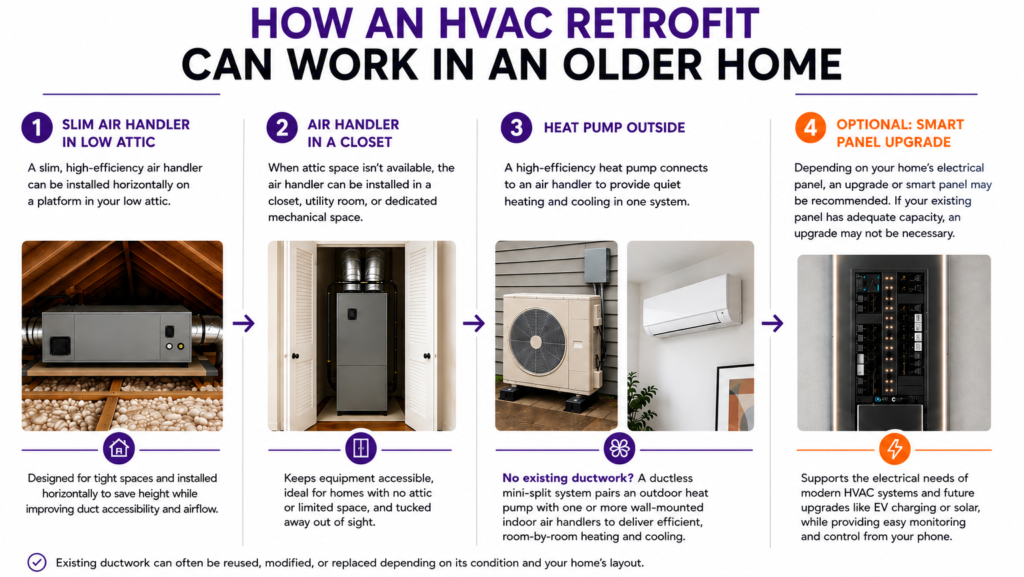
Depending on the home's design, an HVAC specialist may recommend:
- Using existing ductwork, with minor modifications if needed
- Installing new ductwork through attic or crawlspace
- Choosing a ductless mini split system for areas where ductwork isn't practical, such as within Eichler-style homes
- Installing a heat pump that provides both heating and cooling through a single system
The goal isn't simply to install air conditioning. It's to improve comfort while respecting the home you've invested in.
For older Bay Area homes, that means designing a custom retrofit solution that works with the home's existing layout rather than making the home fit the equipment.
Which Cooling System Is Right for Your Home?
By this point, you may be wondering which cooling system is actually the right choice.
The answer is that there isn't a one-size-fits-all solution for older homes. The best system depends on your home's unique infrastructure, how you use the space, your long-term plans, and what you're hoping to accomplish.
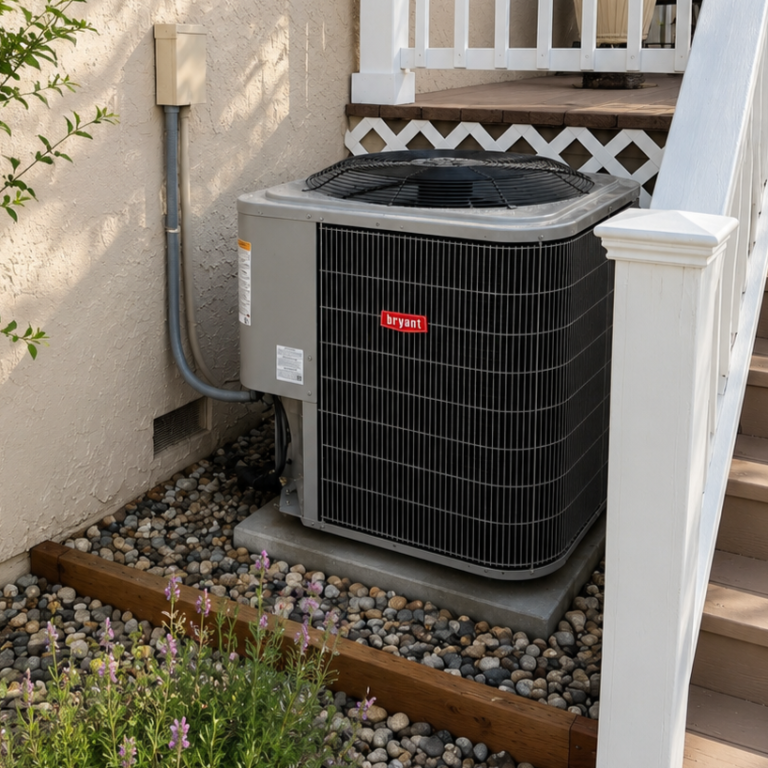
Central AC
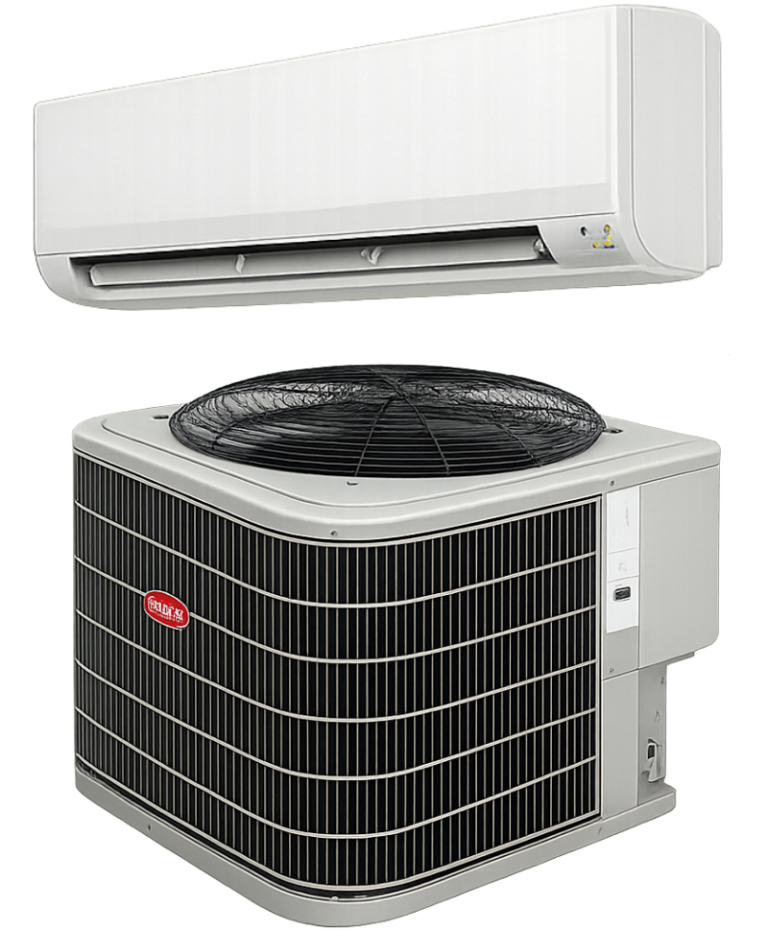
Central air provides whole-home cooling through the existing vents and can be an efficient option when much of the home's infrastructure is already in place.
May be a good fit if:
✔ Home has a forced-air heating system.
✔ The existing ductwork is in good condition.
✔ You want consistent cooling throughout the home.
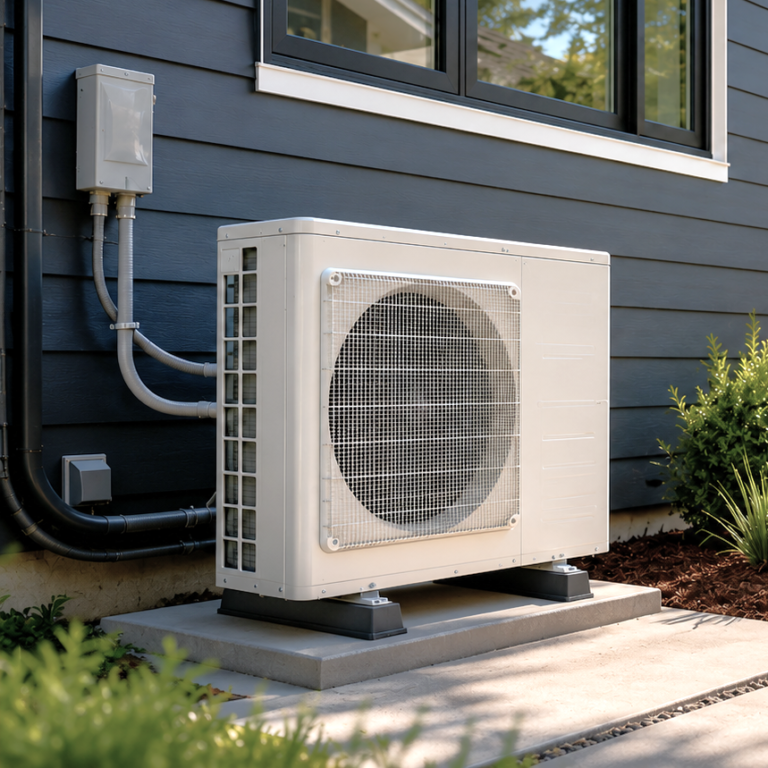
Heat Pumps
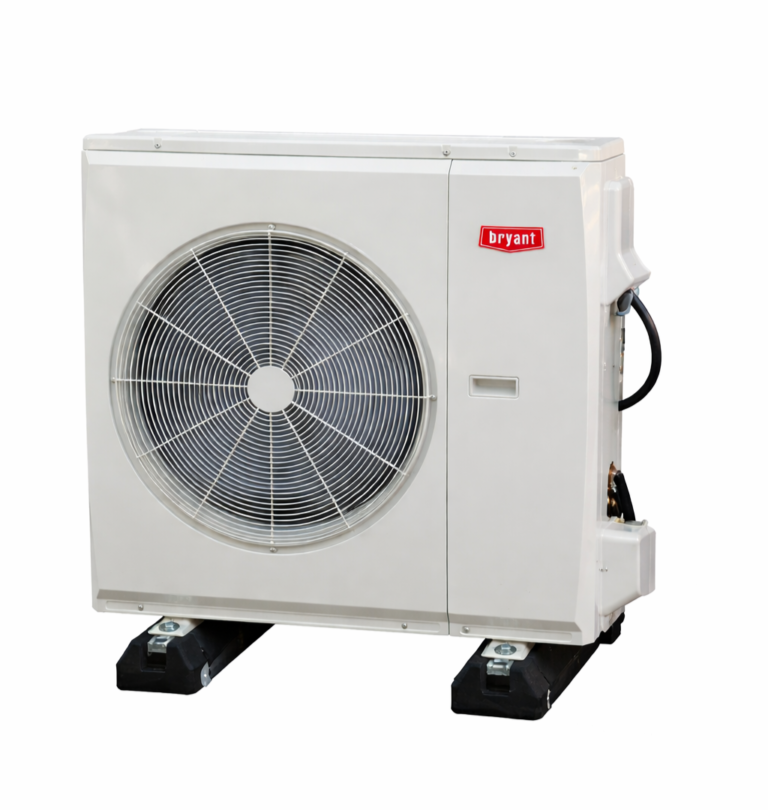
Heat pumps have become an increasingly popular option for Bay Area homeowners because they provide both heating and cooling in a single system.
May be a good fit if:
✔ Replacing both heating and cooling system.
✔ Interested in an all-electric solution.
✔ Energy efficiency and year-round comfort are priorities.
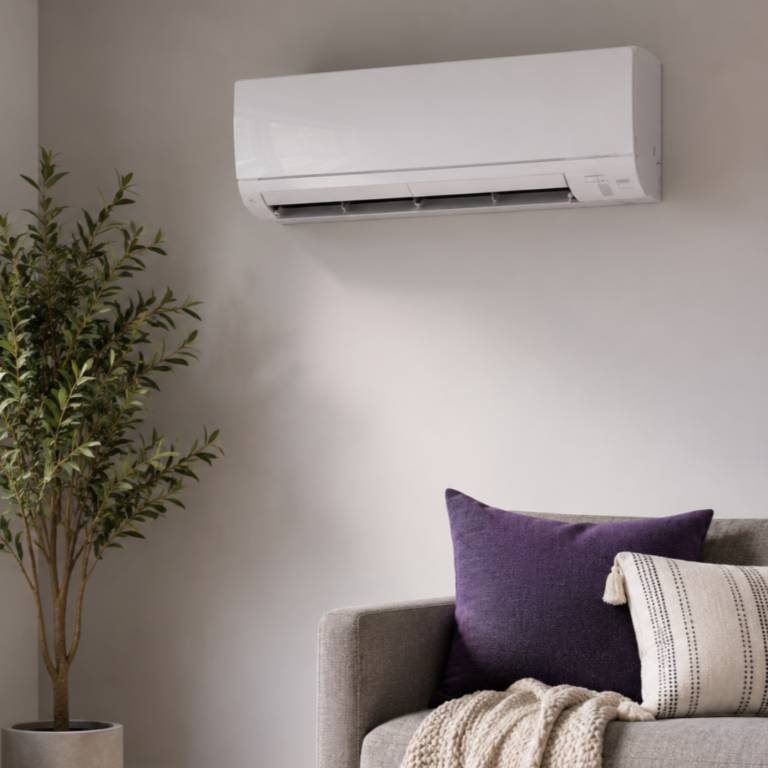
Ductless Mini Split Systems
Ductless mini-split systems provide efficient, room-by-room comfort without requiring ductwork. Their compact outdoor heat pump saves space.
May be a good fit if:
✔ Your home doesn't have ductwork.
✔ You're cooling a specific area or addition.
✔ You want greater control over temperatures in specific rooms.
Which One Is Best?
Each system offers its own advantages, but the best choice depends on how your home was built and what you're hoping to achieve.
That's why a professional HVAC evaluation focuses on understanding the home first. Once the home's layout, existing systems, and comfort goals are understood, the most appropriate solution often becomes much clearer.
How Much Does It Cost to Add Air Conditioning?
Even two similar homes on the same street can require different equipment and installation approaches, which means costs can vary. The exact investment depends on your home's existing infrastructure, equipment selection + rebates, and comfort goals.
Some of the biggest factors driving the overall investment include:
Home Size
The size and layout of your home play a major role in determining the type and size of system needed. A larger home doesn't always require more equipment, but it does require a system that's properly designed for the space.
Existing Electrical System
Some older homes may need electrical upgrades before new cooling equipment can be installed safely. If your home's electrical panel already has the capacity to support the new system, this may have little or no impact on the project.
Existing Ductwork
If your home already has compatible ductwork, installation may be more straightforward. If ductwork needs to be repaired, modified, or installed for the first time, that can influence both the scope of work and the overall cost.
Cooling System Selection
The type of cooling system you choose also affects the investment. Central air, heat pumps, and ductless mini split systems each have different equipment requirements, efficiency levels, and installation considerations.
Permits
Most whole-home air conditioning installations require permits and inspections to help ensure the system complies with local building and safety codes.
At Iris Mechanical, we handle the permitting and inspection process for you, helping make the installation as smooth and straightforward as possible.
Available Rebates and Incentives
Some homeowners may qualify for local utility incentives, manufacturer promotions, or rebates on qualifying high-efficiency equipment. These programs can help reduce the overall cost of upgrading your home's comfort system.
The Best Way to Get Tailored Pricing is an Estimate
The most accurate estimate starts with understanding your home rather than relying on an average price found online.
If you're just beginning your research, our Instant Baseline Estimate is also a great way to get a general idea of your options before scheduling an in-home evaluation. Once we visit your home, we can recommend the best solution and provide pricing tailored to your home's unique needs.
How Long Does It Take to Install Air Conditioning?
For homes where much of the existing infrastructure is already in place, installation is often completed quickly (within 1-3 days). Projects involving new ductwork or additional electrical work may take longer, but we’ll always give you a clear timeline upfront.
Every installation follows a carefully planned process designed to minimize disruption whenever possible.
What to Expect During the Installation Process
While every project is different, most follow a similar process:
- Home evaluation and planning to determine the best cooling solution.
- Equipment installation, including the indoor and outdoor components.
- Any necessary ductwork or electrical modifications, if required.
- System testing and performance checks to help ensure everything is operating properly.
- A final walkthrough, where your HVAC specialist explains how the system works, answers questions, and helps you feel comfortable using your new equipment.
Quality installation focuses on getting each step right. Careful planning, proper equipment sizing, and thorough testing all play an important role in delivering reliable comfort for years to come.
Why an In-Home HVAC Consultation Is Worth It
Many homeowners are surprised to learn that the goal isn't to sell a particular system. It's to understand your home, your comfort goals, and how you use your living spaces every day.
One of the most important parts of that evaluation is properly sizing the system. This begins with a Manual J load calculation, which considers factors such as your home's size, insulation, windows, orientation, and other characteristics to determine the appropriate heating and cooling capacity.
Since every home has its own layout, existing infrastructure, comfort challenges, and long-term goals, an in-home consultation allows an HVAC specialist to evaluate those factors and help you make an informed decision.
Just as importantly, it's a great opportunity for you to ask questions, understand the reasoning behind the recommendations, and imagine which solution you can see yourself living with comfortably everyday.
Every Home Deserves a Thoughtful Solution
Older Bay Area homes weren't all built the same, and neither are the people who live in them.
Since there's rarely a one-size-fits-all answer, the best solution is the one that's thoughtfully designed for you.
Schedule your complimentary Home Cooling Consultation to receive recommendations tailored to your home and your comfort goals.
Still have questions?
Browse more frequently asked questions about adding air conditioning to homes without AC.
Frequently Asked Questions
1. Can you add air conditioning to a home with radiant heat?
Yes. Radiant heat and air conditioning are separate systems, so you can often add cooling without removing a functioning radiant heating system.
Depending on your home’s layout and available space, options may include ductless mini-splits, a small-duct system, or traditional central air with newly installed ductwork. An in-home evaluation can help determine which approach provides the best balance of comfort, efficiency, appearance, and installation impact.
2. Can you add air conditioning to an Eichler home?
Yes. Although Eichler homes were generally built without traditional attics or conventional ductwork, modern cooling systems can often be adapted to their distinctive design.
Ductless mini-splits are a common option because they require minimal structural changes and can cool individual rooms or larger living areas. Other solutions may also be possible depending on the home’s model, roof design, existing radiant heating system, and the homeowner’s preferences.
The goal should be to add reliable comfort while preserving the architectural character of the home as much as possible.
3. Can I cool only part of my home?
Yes. Ductless mini-splits and properly designed zoning systems can provide targeted cooling for selected rooms or areas of the home.
This may be helpful if you primarily need cooling in upstairs bedrooms, a home office, an addition, or frequently used living spaces. The best setup depends on which rooms you use, how air moves between them, and whether you may want to expand the system later.
4. Can you install air conditioning in a two-story home?
Yes, but the system must be designed around the way heat and airflow behave throughout both levels.
Upstairs rooms often become warmer because of attic heat, sun exposure, limited return airflow, or ductwork that does not distribute enough conditioned air to the second floor. Depending on the home, the solution may involve improving the duct system, adding zoning, using multiple thermostats or sensors, or installing ductless equipment in harder-to-cool areas.
A properly sized system should address the home as a whole rather than simply adding a larger air conditioner.
5. How long does an HVAC consultation take?
At Iris Mechanical, most in-home HVAC consultations take about 30 to 60 minutes, depending on your home's size, existing equipment, and the complexity of the project.
During the visit, we'll evaluate your current heating and cooling system, inspect the ductwork (if applicable), review your electrical setup, discuss your comfort goals, and determine which solutions best fit your home. If needed, we'll also gather the information required to properly size your new system before providing recommendations and pricing.
Our goal is to provide recommendations tailored to your home, not a one-size-fits-all solution.
6. Does adding air conditioning increase home value?
Yes. In many cases, adding air conditioning can increase your home's value while also making it more attractive to potential buyers.
As Bay Area summers continue to warm, more homeowners view air conditioning as an expected comfort rather than a luxury. Although the exact impact on resale value varies by home and neighborhood, a professionally designed and properly installed system can improve everyday comfort, energy efficiency, and future buyer appeal.
7. How do I know if my electrical panel is large enough?
The panel label or amperage rating alone doesn't provide the complete answer. A qualified professional should evaluate your home's existing electrical loads, available breaker space, service capacity, and the power requirements of the new system.
Some homes can support a new air conditioner or heat pump without replacing the panel. Others may need a new circuit, electrical modifications, load-management equipment, or a panel upgrade.
If you're planning additional upgrades, such as an EV charger, solar, battery storage, or a heat pump water heater, it may also be worth considering a modern smart electrical panel, such as Eaton or SPAN, to help support future home electrification and energy management.
Every home is different, so your electrical system should be evaluated during the planning process to determine the best path forward.